The 6th edition of the NFH survey, released by the Ministry of Health and Family Welfare, is a nationwide survey to collect important health-related data and the well-being of the population. It is India’s component of the global Demographic and Health Surveys (DHS) Program, which is funded primarily by the United States Agency for International Development (USAID). Following the U.S. government’s decision to stop USAID activities and foreign aid programs in India, NFHS-6 is fully supported by the Ministry of Health and Family Welfare (MoHFW), Government of India.
Data from the National Family Health Survey-6 was made public by the Health Ministry. Child Health Indicators have improved over the last survey. The percentage of children under five who were stunted decreased from 35.5% to 29.3%. The percentage of severe wasting decreased from 7.7% to 5.2%. The percentage of underweight children decreased slightly from 32.1% to 31.8%.
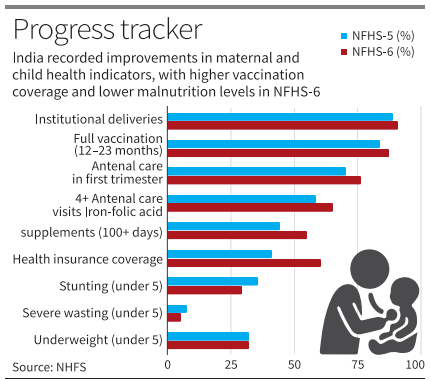
The survey highlights progress in Maternal Health. In NFHS-5 (2019–21), institutional deliveries increased from 88.6% to 90.6%. Prenatal care was provided to 95.9% of pregnant women.
Immunisation rates have also increased. The percentage of people who were fully vaccinated increased from 82.8% to 87.1%.
In 2023–2024, the Total Fertility Rate (TFR) stayed constant at 2.0, marginally below the replacement threshold of 2.1.
However, it found an increase in cesarean sections. The 40% C-section rate greatly exceeded the World Health Organisation’s suggested range of 10-15% in urban areas.
Full vaccination coverage among children aged 12-23 months increased from 83.8% to 87.1% based on vaccination cards, with 95.6% of children receiving the majority of their shots from public health facilities. Rotavirus vaccination coverage increased significantly among important vaccinations, from 36.4% to 85.4%. Additionally, the coverage of the second dose of vaccines containing measles improved significantly from 58.6% to 71.8%.
According to the survey, the percentage of women between the ages of 15 and 24 who utilise hygienic methods of menstrual protection has increased from 77.6% to 79.2%.
