The Stockholm International Peace Research Institute (SIPRI) recently published its 2026 data, revealing significant shifts in global military spending, nuclear stockpiles, and arms import dynamics. SIPRI, founded in 1966 at Solna in Stockholm, Sweden, is an independent international institute dedicated to research into conflict, armaments, arms control, and disarmament. First published in 1969, the SIPRI Yearbook is the standard annual reference work in the field of international security analysis.
The report reveals the sobering reality that nuclear disarmament globally remains a distant prospect as nuclear-armed nations continue to modernize and grow their nuclear stockpiles. There are nine nuclear weapons states in the world today. That includes the permanent five members of the UNSC (P5: the US, Russia, the UK, France and China) plus India, Pakistan, North Korea and Israel. Altogether, these countries are believed to have some 12,187 nuclear weapons. And crucially, the US and Russia have almost 90% of the world’s entire stock.
India’s estimated nuclear warheads increased from about 180 in early 2024 to around 190 in early 2025, according to the recently released SIPRI report 2026. While Pakistan’s nuclear stockpile is estimated at around 170 warheads as of January 2025. And India remains the world’s fifth biggest military spender, behind the United States, China, Russia and Germany. Major suppliers include Russia, France, and Israel.
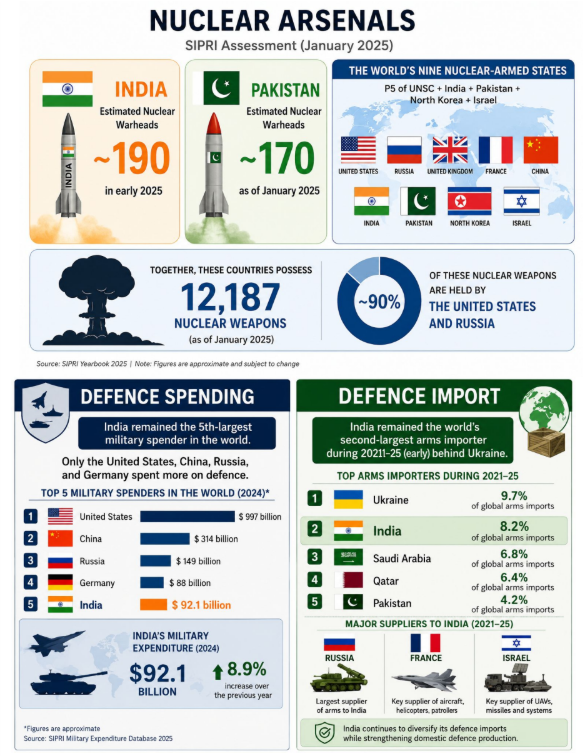
India’s huge defence budget is necessary to deal with regional imbalances but it also reflects the huge burden on the national exchequer, sometimes crowding out capital expenditure on civil infrastructure. And being the world’s second-largest arms importer highlights a critical vulnerability in India’s quest for strategic autonomy. Relying on foreign supply chains puts the country vulnerable during global crises or sudden diplomatic realignments. The high import ranking underscores why initiatives like Aatmanirbhar Bharat in defense, positive indigenization lists, and defense industrial corridors are absolute necessities rather than choices.
