We share open borders, deep cultural ties, and centuries of shared history.
But recently, the diplomatic stance from Nepal has started to change. Nepal is witnessing a massive generational shift in its politics, and with it, old historical border disputes are being looked at through a brand new lens. Historically, India is used to dealing with the “OGs” of Nepali politics, veteran leaders from the Nepali Congress who usually take the Indian stance or the various Communist parties, naturally inclined towards China . We knew their ideologies, their red lines, and how they negotiated.
Today, that landscape has completely transformed. A massive youth-driven movement was recently seen in the country. Nearly 38% of Nepal’s current lawmakers are under the age of 40. The ruling Rastriya Swatantra Party (RSP) represents this new face of Nepal’s polity. Recently, the RSP’s chief, Rabi Lamichhane, met with Prime Minister Narendra Modi in New Delhi, one of the highest-level visits since this new government took power.
The Root of the Friction
Following the Anglo-Nepalese War, the British East India Company and the Kingdom of Nepal signed the Treaty of Sugauli in 1816. This treaty is the bedrock of the modern India-Nepal border. Under the treaty, the Kali River, also known as the Mahakali or Sharda River, was designated as Nepal’s western boundary. Everything east of the river belonged to Nepal, and everything west belonged to India.
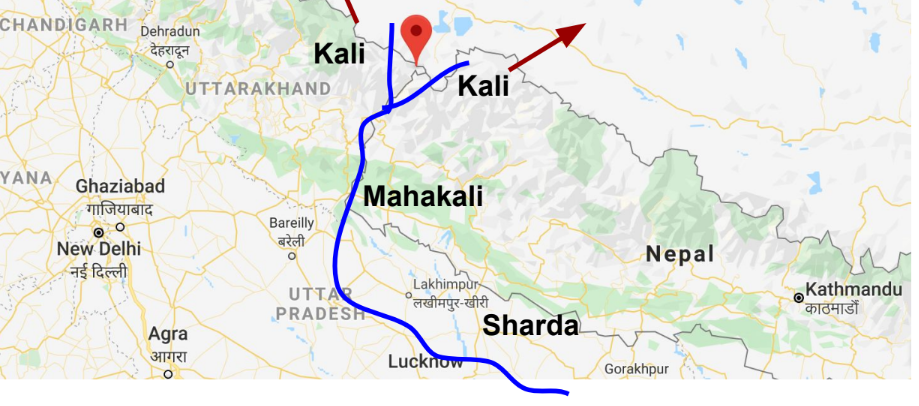
High up in the Himalayas, they are formed by multiple streams joining together. The Kali River is formed by two main mountain streams, and the entire dispute gets down to one question: Which of these two streams is the “real” starting point of the Kali River?
India’s Stance: India argues that the river originates just below the Lipulekh pass. If you draw the border from this stream, the highly strategic Kalapani region falls on the Indian side (part of Uttarakhand). Nepal’s Stance: Nepal argues that the river originates further northwest at a place called Limpiyadhura. If you draw the border from this stream, the Kalapani region falls inside Nepal.
Border disagreements are normal between neighbors, but PM Balen Shah recently turned up the heat with a bold public statement. He claimed that not only has India encroached upon Nepalese territory, but Nepal has also occupied Indian territory in certain areas. Instead of the usual quiet diplomacy, PM Shah suggested that both nations need to sit down “like friends” to resolve the issue once and for all. However, he crossed a major diplomatic red line for New Delhi by suggesting that, if necessary, they should bring in third parties like China, the UK, or international historians and surveyors to mediate.
India essentially ignored the unexpected claim that Nepal has occupied Indian land. However, India firmly rejected any third-party intervention. New Delhi maintains that Kalapani is an integral part of Uttarakhand and insists that any border disagreements must be solved purely through one-on-one dialogue between India and Nepal—no China, no UK, and no outside mediators.
